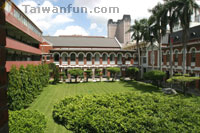
The courtyard at the Taichung
City Government Building.

Room temperatures are kept at
a strict 28℃ (82℉) to help
conserve energy.

The opening of a natural gas
station.

Cycling is strongly encouraged.

Bao Zhi Lin, a furniture
recycling center run by the
Taichung City Bureau of
Environmental Protection, has
beautiful surroundings.

Bao Zhi Lin takes in old
furniture and repairs it to help
reduce CO2 through re-usage.
|
Taichung City Government: A role model in reducing our carbon footprint
Words and photos by Taichung City Government
Translated by Sho Huang
In response to global warming, Taichung Mayor Jason Hu and his city government team are promoting a new campaign to help reduce pollution and resource waste--and they are setting the example themselves. The government's recommendations can easily be adapted to almost anyone's lifestyle and simply seeks to avoid wasting water and electricity. With everyone working together to lower pollutants, Taichung and Taiwan can help reduce our global carbon footprint.
The Ministry of Economic Affairs' Bureau of Energy is promoting the slogan, "Low-CO2-Production Economics and Lifestyle", that will hopefully serve as a reminder to drastically reduce waste. The government is setting the example in this campaign by making several changes around its offices and support buildings. These changes include: staff reminders to each other to turn off water and lights; office equipment and unnecessary lighting shut-downs during the lunch breaks; keeping air conditioners at 28℃; not using the air conditioners during overtime hours; avoiding unnecessary meetings; encouraging public transportation; carpooling; and replacing high energy-consuming products with more efficient and longer-lasting options.
As natural energy resources run low and the world tackles global warming, it's essential to reduce the globe's already-heavy C02 burden. That is why the mayor has been urging his team to practice energy-saving methods and leave their old habits behind. After all, it's everyone's responsibility to work toward cutting down emissions and waste. After trying this new system, the government compared power usage from January to June 2008 with 2007. The results were quite positive-- it was 4.74% lower than the same period in the previous year and saved the government NT$266,286. This obvious progress resulted from simple acts, like turning off the water and lights when they weren't necessary.
Changing your lifestyle to be more "green" not only helps Mother Earth, but is also easier on your pocketbook. Using alternative heat, lighting and power sources, as well as being responsible with your current system, will have a positive impact on your life and the overall health of the planet.
| Reducing your carbon footprint isn't all bard--here are some common "carbon eating" activities as well as the levels of CO2 they create, plus the level of difficulty for changing your habits, and alternative methods and solutions. |
Event |
Daily activities |
CO2-reducing level |
Alternative |
| Using the clothing dryer for one hour creates 0.828 kg of CO2. |
extremely high |
very easy |
Use sunlight, wind to dry clothes. |
| Using the AC for one hour creates 0.621 kg of CO2. |
extremely high |
very easy |
Keep the windows open and use fans. |
| Using the water heater for one hour creates 0.276 kg of CO2 |
very high |
medium |
Don't use as often. |
| Using the elevator creates 0.218 kg of CO2 |
very high |
very easy |
Use the stairs! It's also good for your health. |
| Driving a car for 1 km creates 0.220 kg of CO2. |
very high |
easy |
Walk, ride a bicycle, or take the bus. |
| Using a microwave for 10 minutes creates 0.138 dg of CO2 |
high |
very easy |
Avoide microwaving food. |
| A hot bath/shower creates 0.078 kg of CO2. |
medium |
very easy |
Take a cold/cool shower or bath in the summer. It's quite refreshing. |
| Driving a scooter for 1 km creates 0.055 kg of CO2. |
medium |
easy |
Walk, ride a bicycle, or take public transportation to reach your destination. |
| Using one 60-Watt light bulb for an hour creates 0.041 kg of CO2. |
medium |
very easy |
Turn off lights when they are nt needed, use energy-saving bulbs, candles. |
| Using 60-Watt fluorescent lights for an hour creates 0.017 kg of CO2. |
low |
easy |
Ture off light when they are not needed, use energy-saving light bulbs. |
|

 July 2008

