A love for bamboo and fun
with weaving: Bamboo weaving master Liu Qin-lin
Words by Ye Jia-hui
Translated by Angela Cheng
Photography by You Jia-huan
Is bamboo weaving only limited to agricultural tools, containers, baskets and other
everyday items?
Liu Qin-lin entered the bamboo weaving world at a young age, and returned to this fun,
creative field after retirement. His weaving skills are delicate, allowing him to transform
everyday items into works of art. When a sense of aesthetics grows in our lives, it fills
us with warmth.
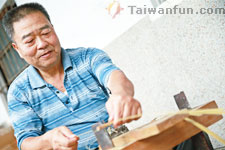
With the longan tree branches weighted down with fruit, it's easy to grab a handful by just reaching out and picking a bunch. "The countryside is like this! The weather warmed up late this year; otherwise, this would be the time to enjoy delicious, ripe longan," comments Liu, leading us along a trail next to his red-brick house. It felt like an entry into a different world--one with a barn, rice patties and thorn bamboo. The corridor in front of the main hall is where Liu normally does his weaving. "Because there's great light here, and no need to move around if it's raining, it's very convenient!" he comments with a smile.
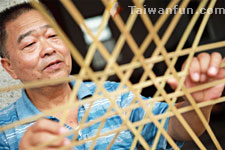 
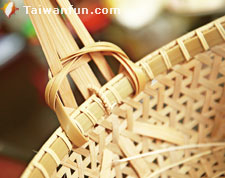
Left: After retiring, Liu has returned to his artistry and
enjoyment of bamboo weaving, conjuring up fun
childhood memories.
Right: Liu Qin-lin makes bamboo weaving more delicate and artistic, in a great contrast
to traditional weaving.
Retirement: Back to enjoying the fun of bamboo weaving
Taichung's Dongshi district is Hakka country, inhabited by a people renowned for their diligence and pragmatism. Probity, a willingness to persevere, and no fear of hardship are all traits that come naturally to Liu. He recalls that learning bamboo weaving came very naturally to him. In his mind's eye, he always remembers his parents, relatives, friends and neighbors all cutting and weaving bamboo products like hats and baskets in their homes, courtyards and fields. At the time he was born, Dongshi town, Taichung county's Shicheng district, was home to a prospering bamboo weaving industry in its heyday." Located near mountainous bamboo forests, Dongshi's bamboo was an important local crop. Locals not only used it in home construction and furniture-making, but families would also weave it in their spare time to meet specific agricultural or household needs, or for sale to boost family income. Growing up in this environment, Liu became very familiar with the process and not only was able to help the family weave by age 7, but would also try to complete semi-finished products by himself while his parents farmed. His home was the classroom that forged his intuitive and nimble weaving skills.
Though he developed a special intuitive feel for bamboo weaving and it made up a big part of his childhood, plastic products and lower-priced imports from China eventually eroded the market. Thus, it didn't require much consideration to choose work at a factory instead. This 9-to-5 life lasted for 30 or 40 years, until a few years ago when he retired. This finally gave him time to once again devote himself to his favorite craft.
 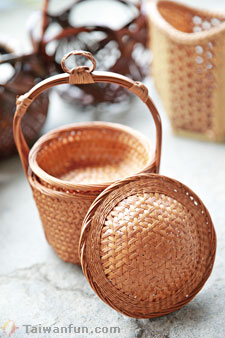
Right: A mini version of a bamboo basket
underlines the workmanship.
Cutting bamboo: A test of a master's true skill
Bamboo has a texture that is solid, flexible, tough and nice for splitting, although each kind of bamboo has its own unique qualities. For example, gui bamboo has a nice elasticity and a moisture-proofing effect. Ma bamboo has a soft texture, while long branch bamboo is tough and hard to split. To get the best effects one must be careful in their choice of materials. After treating his material, Liu is ready to prepare some bamboo pipes. He explains that generally only the middle section of the bamboo is used--avoiding the 'eye' or joint portion--because the ends are not even and the root end is hard to cut into slices. Nice bamboo strips must be of even width, thickness and quality, so that they are easier to manipulate, giving finished products smoother, more beautiful lines. While the job of preparing bamboo strips in repetitive and monotonous, it is the most important factor impacting work quality and is the best test of a bamboo master's skills.
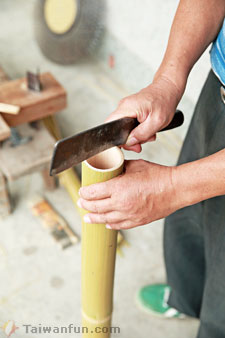
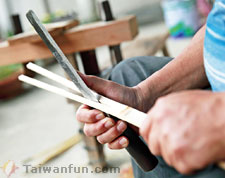
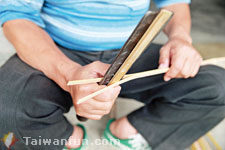
Left: Slicing bamboo looks easy, but controlling cutting
strength is the hardest part.
Right: Liu slices bamboo with his self-designed knife set and his work is neat and
efficient.
The process of making bamboo-weaving products generally has several steps, starting from selecting the material, scraping and cleaning it off, cutting strips, dividing them apart, fixing the width and thickness, and weaving. Painting and other steps may also be taken. The tool Liu uses to split bamboo is a simple long knife, plus a set of self-designed knives. As he shaves the bamboo's fibers, he explains that each bamboo master uses different tools, with customized knives adjusted for fixing the width on one side and the thickness on the other. Fixing the height can fix the width--simply adjusting the placement of the bamboo to a more efficient position allows for more accurate bamboo-slice widths. The knife set is used for adjusting the thickness; holding the knife in the right hand and using the left to pull back, in an action that is repeated until the slices are even. Through these steps to prepare the bamboo strips, Liu creates a uniformity in thickness, length and width, making them now suitable materials for his refined weaving abilities.
Left: Completed works highlight quality and durability,
particularly around the jointed parts in these creations.
Right:
Cutting bamboo is the most basic and important work for a
bamboo weaving craftsman.
Tradition transformed into fashion
Traditionally, people associate bamboo weaving with hats, baskets, cages and other everyday items, but Liu no longer makes items like these, instead using bamboo weaving to produce art. Sometimes his works are small and delicate, while he uses others to highlight the elegance of the weaving texture. He has also combined weaving with patchwork, pottery and lacquer to expand his artistic expression. Depending on the item being made, Liu uses different weaving techniques, such as triangular weaving, hexagonal weaving, square weaving, "mi" shaped weaving, "ren" shaped weaving, windmill weaving and double triangle weaving. Each method produces different textures, levels of durability, elasticity and other features, making each quite unique. Liu uses different patterns for different purposes. If a work is for display, he can change the weaving spacing or mix different techniques; if it's a bag for daily use, he prefers to emphasize the softness of material and patterns. Liu's beautiful creations have changed people's perspectives on what bamboo art is, and now most of his works are for exhibitions.
Left: There are a variety of bamboo weaving methods.
Right: Adding a piece of bamboo behind the knife when
cutting bamboo can make it easier to separate
bamboo fibers.
Sharing the satisfaction of desired creations
Unlike Liu Qin-lin, who grew up with bamboo weaving, his children do not share the same special feeling for this craft. They are, however, willing to inherit their father's skills. Based on the idea of sharing and promotion, Liu teaches basic bamboo weaving skills at farmers' associations or any school association interested in learning. "If people are willing to learn, I am happy to teach and help everyone understand that bamboo weaving is very practical, and can also bring out everyone's artistic accomplishments. That is enough!" he says with a smile.
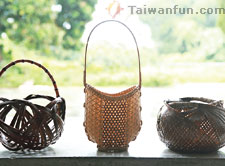 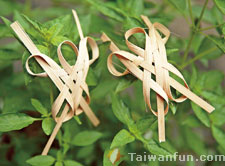
Left: Liu has taken a creative direction, aiming to make bamboo baskets more amazing and
diverse than traditional ones.
Right: In order to make people more interested in bamboo weaving,
Liu teaches students how to make toys, inspiring enthusiasm.
Liu Qin-lin
375, ShiCheng St., Dongshi Dist., Taichung City |

 September 2014

